
Insight beyond sight
World leaders in autonomous heavy vehicle inspections
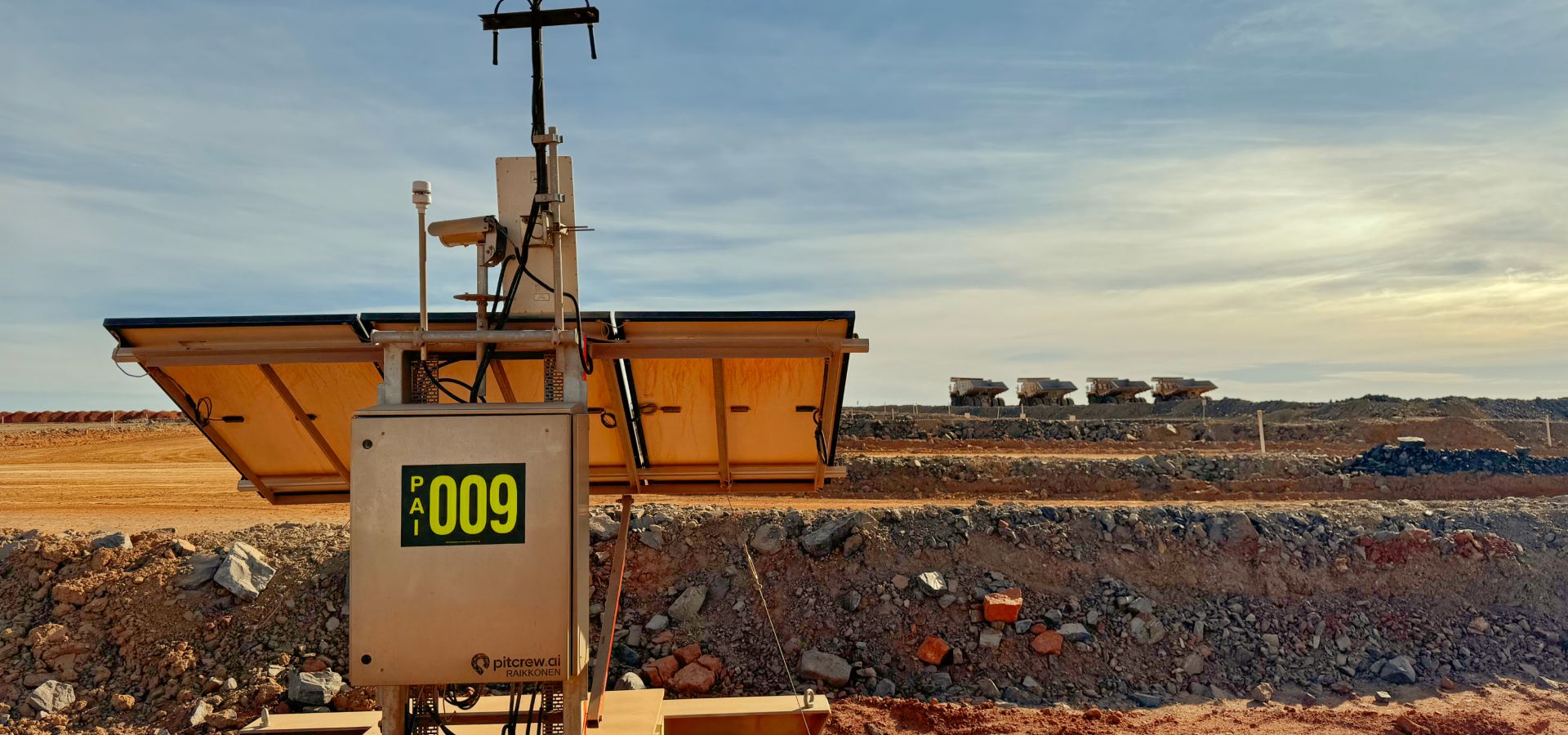
Thermal tyre, brake and hub inspection as haul trucks and B-doubles drive past at operating speed. No stopping, and nothing fitted to the vehicle.
672,000+ tyre inspections in the 12 months to early 2026, across Australia, North America, South America, Africa and Asia.
Trusted by tier-one mining operators
Manual inspections miss what matters most
A haul truck tyre with an active tread separation looks identical to a healthy one. So does a trailer hub forty minutes from a wheel-off. The damage that ends in a fire or a defect notice starts as heat.
Once a shift, at best
is how often a manual check samples a tyre, brake or bearing. Faults that start between checks go unseen until the next one.
- What a walk-around sees
- Tread and sidewall that look intact. Normal pressure, and a silent TPMS.
- What thermal sees
- A separation 20 to 50 °C above the surrounding rubber. Brake drag and hub heat, against the other wheels.
How it works
Instant insights for informed decisions
-
Drive through
Units install at the roadside: beside a haul road, at a pit exit, or in the lane at a depot entry. Vehicles pass at normal operating speed, with no stopping and no driver action.
-
AI analyses every pass
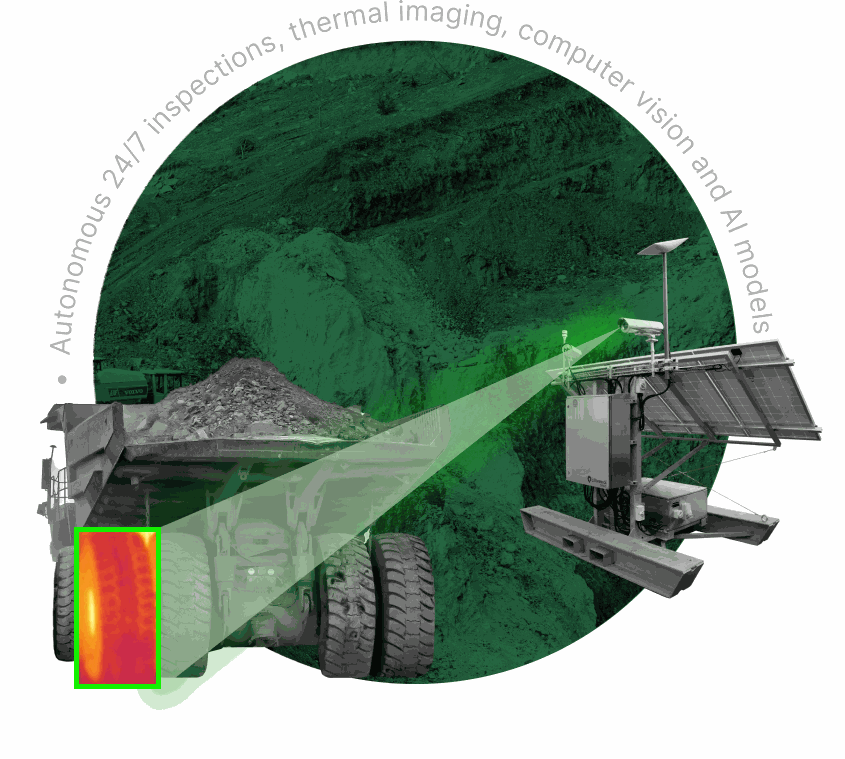
Calibrated FLIR thermal cameras capture surface temperature across every visible tyre position, brake, hub and drivetrain component. Computer vision compares each reading across axle groups and against that position's own history.
-
Your team acts
Anomalies above your thresholds raise alerts through the Pitcrew Dashboard, by email, or into your work order system by REST API, routed by Trigger Action Response Plans you set per site.
Thermal inspection
Thermal tyre inspection and thermal imaging for mining
Failing tyres generate heat before they show damage. Long-wave infrared cameras map surface temperature across tread and sidewall, so a separation shows up on a tyre that still looks perfect.
- Tread separations: a hot spot 20 to 50 °C above surrounding tread
- Brake drag: heat at the rotor, calliper or drum, against the other wheels
- Bearing and hub faults, and sealed injuries where heat builds with nowhere to vent
How thermal detection works
When the tread separates, the unbonded layers rub under load and that friction conducts outward as a hot spot. A developing separation runs 20 to 50 °C above the surrounding tread, and multi-pass trending with cross-axle comparison picks up small, persistent differentials well before alert thresholds. Detection holds across ambient conditions because the system compares differentials rather than absolute temperature. Normal OTR surface temperature is 60 to 80 °C.
Tyre fires and AHS
Haul truck tyre fire prevention and autonomous haulage (AHS) inspection
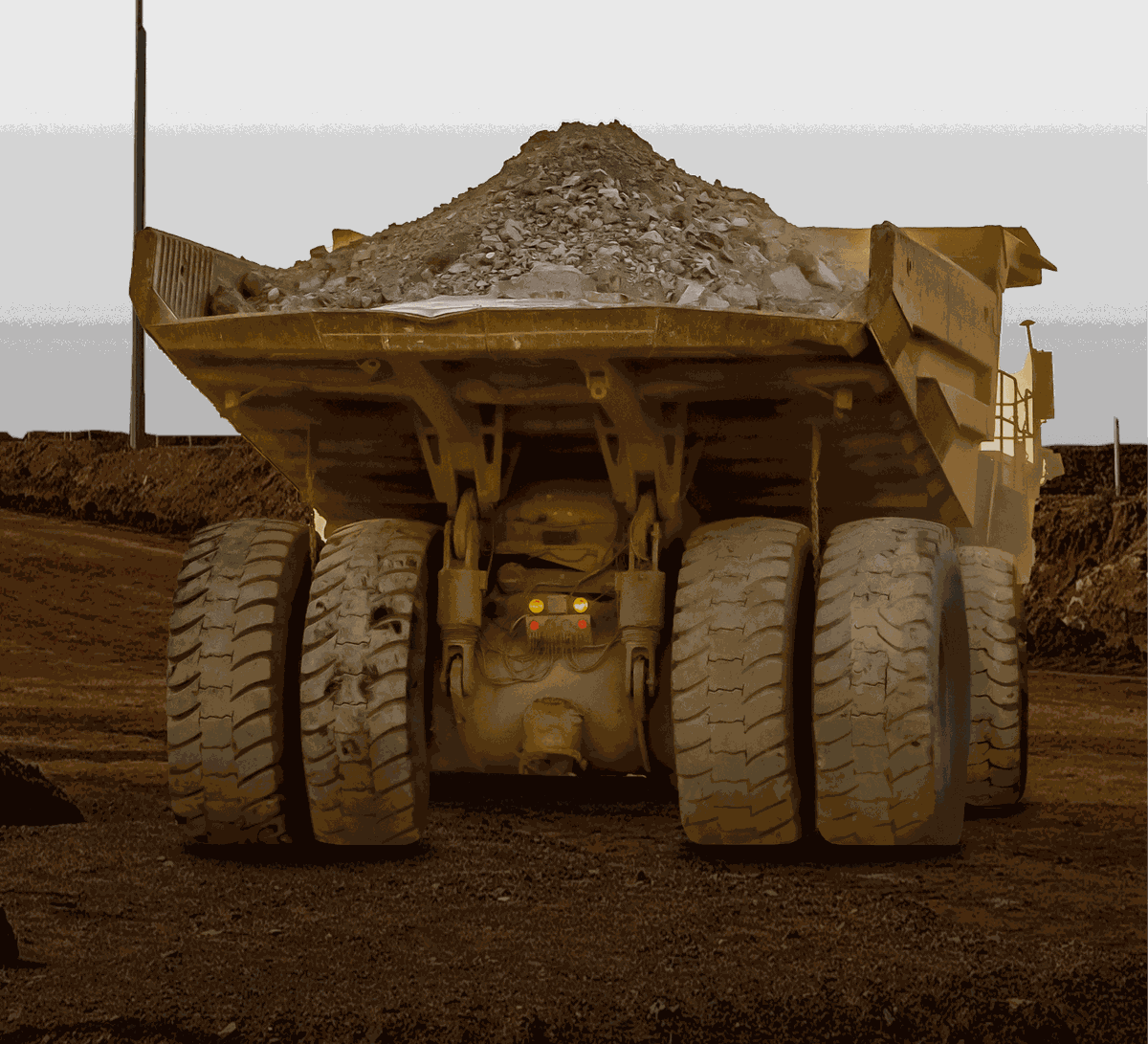
A tyre fire is the end of a predictable progression: tread separation, friction, heat, ignition. Every stage before the last one leaves a thermal signature. Remove the driver and there is no walk-around, no felt vibration and no smell of burning rubber to catch it.
On the haul road
- A single OTR tyre fire shuts a haul road for 8 to 16 hours
- Total event costs reach US$500,000 to US$2 million once tyres, rims, repair and lost production are combined
- Early detection preserves the option of a controlled change at US$30,000 to US$70,000
On a driverless fleet
- Fleet-agnostic: inspects any truck passing the zone, including Caterpillar MineStar Command and Komatsu FrontRunner fleets
- No integration into the AHS control system, and no interruption to dispatch or traffic sequencing
The temperatures, and the window they give you
Tread separation is the single most common precursor to OTR tyre fires in open-cut mining. A developing hot spot runs 20 to 50 °C above baseline tread while the rest of the tyre sits at 60 to 80 °C. Rubber degrades at around 150 °C and undergoes pyrolysis from around 250 °C, releasing gases whose auto-ignition point industry guidance puts above roughly 400 °C. The progression takes hours to days.
Why the gap grows with every AHS truck
Crewed haulage relies on three inspection layers that vanish under AHS: pre-start walk-arounds two to three times a day, sensory detection during operation, and observation at fuel bays and load points. GPS, LiDAR, radar and cameras are built for vehicle control, not component health. The global autonomous haul fleet reached 3,832 trucks in July 2025, up 84 per cent year on year, with 1,024 in Australia.
Map where a unit would sit on your haul circuit or AHS deployment.
Book a discovery callNHVR compliance
NHVR and Chain of Responsibility brake, tyre and hub inspection
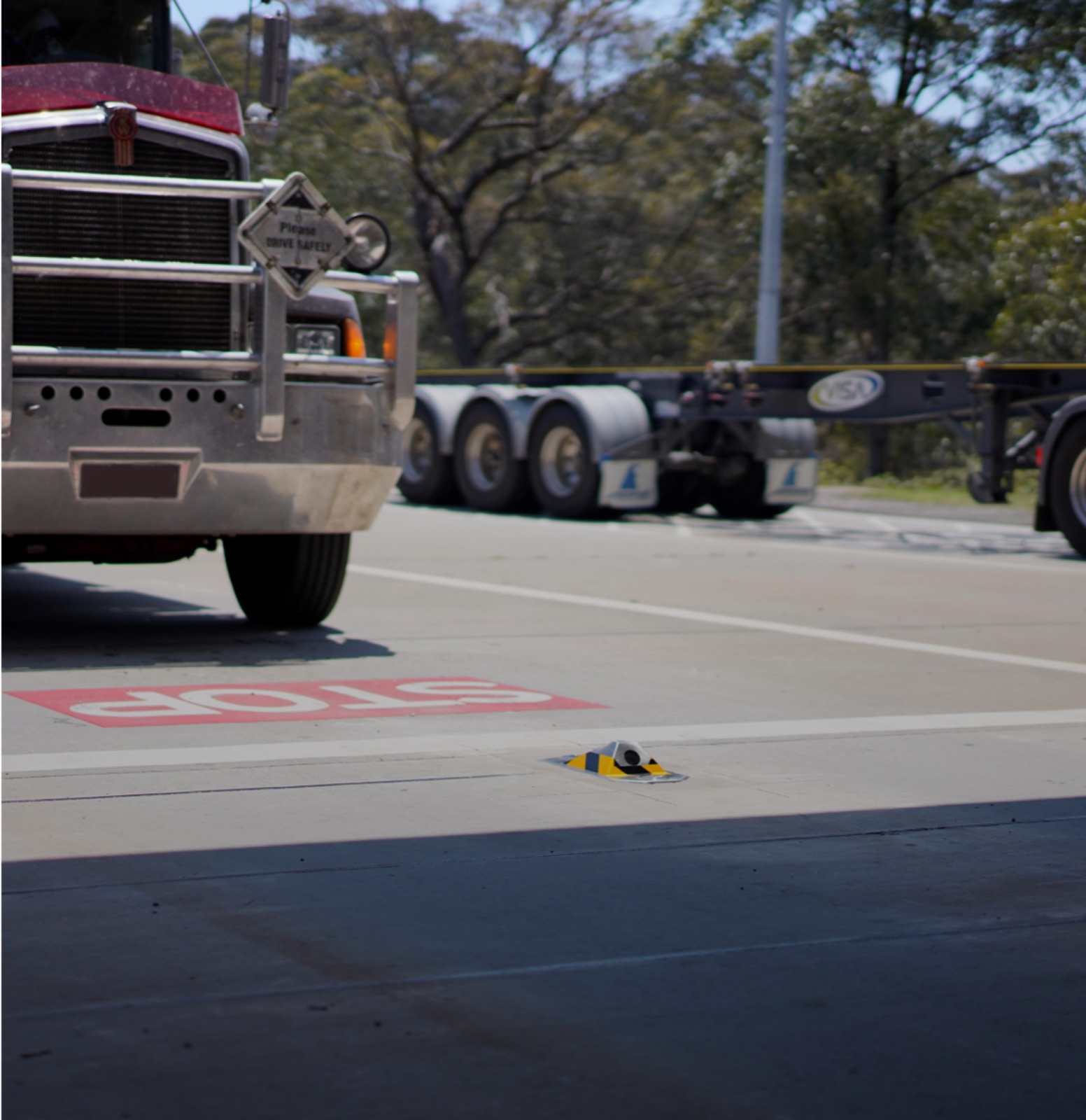
Manual roadside inspection is sample-based and subjective. Pitcrew On-Road screens every heavy vehicle passing a depot entry or weighbridge at road speed, and writes a timestamped record for every axle group.
- Brake faults: overheating, dragging, seized callipers, asymmetric heat that lengthens stopping distances
- Tyre and sidewall anomalies indicating separation, underinflation or progressive degradation
- Elevated hub temperature, which is how you prevent a wheel-off
What the records do for your primary duty
Three FLIR cameras, one in-road and one each side of the lane, cover brakes, sidewalls, hubs and bearings across all axle groups, including trailer axles. Comparing temperatures within each axle group means operational heat from braking or topography does not surface as a fault. Timestamped inspection records help demonstrate how you meet your primary duty under the HVNL and wider Chain of Responsibility obligations. This is a due diligence tool, not a legal certification device, and not legal advice.
Scope a depot or weighbridge installation.
Book a discovery callFleet and OEM
OEM, truck manufacturer and fleet platform compatibility
The cameras sit beside the road, not on the vehicle. One installation covers a customer's whole mixed fleet, any brand, crewed or autonomous, with no per-model engineering programme.
- Works with any standard six-wheel rigid dump truck, crewed or autonomous
- No on-vehicle hardware, so no sensor inventory and no re-certification on an autonomous truck
- Results by REST API and CSV for fleet management, CMMS and dealer service platforms
What an integration looks like
The platform is also resold internationally through a global tyre service partner. Alert thresholds and Trigger Action Response Plans are configured per site, so escalation follows the customer's own maintenance strategy. Underneath sits a thermal condition history for every wheel position: the data layer behind condition-based scheduling and casing preservation for retreading.
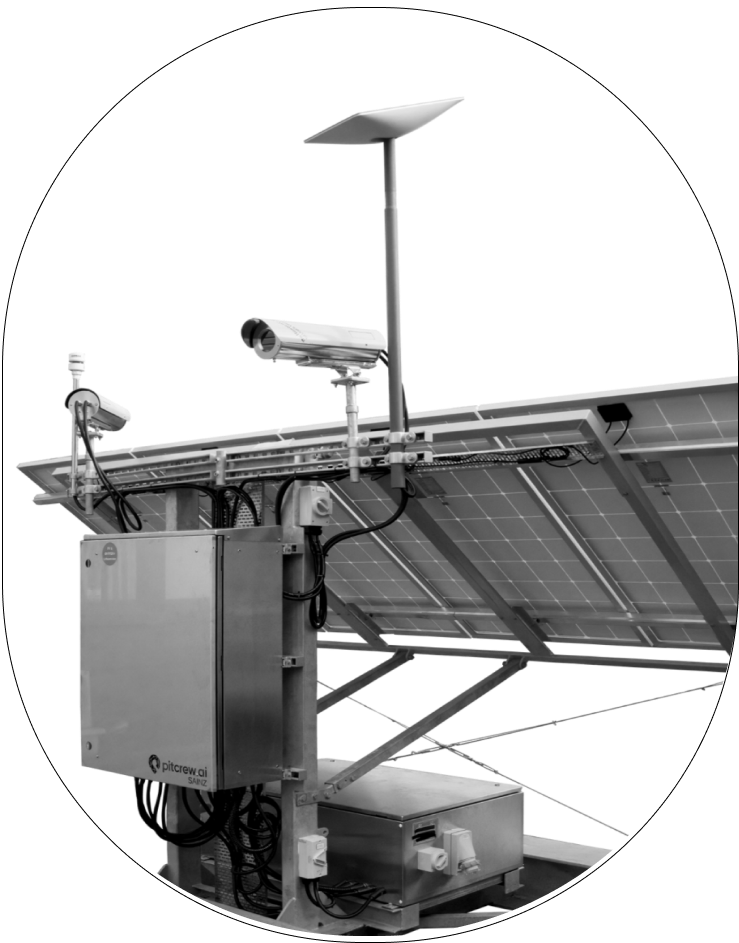
Two systems. One mission: prevent what you cannot see
| Pitcrew AISmining / OTR | Pitcrew On-Roadcompliance / fleet | |
|---|---|---|
| Built for | Haul truck tyres on mine sites | Heavy vehicles at depots and weighbridges |
| Cameras | Two FLIR thermal cameras | Three: one in-road, one each side |
| Where it sits | Haul road, pit exit, dump approach | Depot entry, weigh station, inspection lane |
| Mounting and power | Trailer or skid-mounted, solar with battery backup | Fixed lane installation, site power |
| What it reads | All visible tyre positions, brakes, hubs, drivetrain | Brakes, sidewalls, hubs, bearings, all axle groups |
| Detection logic | Anomaly against thresholds and position history | Thermal asymmetry left-to-right and axle-to-axle |
| Vehicles | Crewed and autonomous haul trucks, any platform | B-doubles and multi-combination, in HVNL scope |
The Pitcrew difference
Not a dashboard. Not a sensor. An inspection system.
-
Nothing on the vehicle
An external roadside system. No onboard sensors, no in-tyre hardware, nothing to manage at a tyre change. It works on any vehicle that drives past.
-
Sees what TPMS isn't designed to detect
TPMS measures pressure inside the tyre. Separations generate heat in the tread, behind up to 180 mm of rubber, which conducts heat roughly 300 times worse than steel.
-
Every vehicle, every pass, 24/7
Continuous inspection at operating speed. Manual scans cover a sample once a shift at best; Pitcrew reads every position on every pass and trends it over time.
-
Audit-ready from day one
Every inspection is timestamped and logged, flagged or not, and exports by REST API or CSV. The evidence exists before anyone asks for it.
Pitcrew is globally recognised
- GRX26 Industry Awards (Austmine and AusIMM): winner, Craig Senger Excellence in Export Award, supported by Austrade
-
 2026 NSW Export Awards: winner, Resources and Energy
- 2026 Hunter Manufacturing Awards: winner, Excellence in Export and Global Supply Chains
- 2026 Hunter Manufacturing Awards: winner, Excellence in Innovation
-
 2022 CORE Innovation Hub Hot 30 Awards: winner
-
 InnovationAus 2021 Awards: finalist, Mining Equipment, Technology & Services
-
 2023 Global Mining Technology Awards: finalist
-
 2021 Australian Mining Prospect Awards: finalist, Excellence in IIoT Application
Book a discovery call
Fifteen minutes with the Pitcrew team. Tell us what you run and we will show you what the thermal data looks like on a fleet like yours.
Not ready to talk yet?
With Pitcrew AIS we have the capacity to monitor over 200 tyres per week. If we did not have it, each tyre would need to stop for more than 30 minutes to be checked, but now it is monitored remotely.
Frequently asked questions
How is a Pitcrew unit installed, and how long does it take?
Mining units are trailer-mounted to relocate between haul roads and pit exits, or skid-mounted permanently, running on solar with battery backup. On-road systems install in the lane. Typical deployment is two to four weeks* from site survey to operational status.
*Where hardware is available.
Does this replace our TPMS?
No. They detect different things and work best together. TPMS measures internal pressure and cavity temperature, and is good at underinflation and slow leaks. Pitcrew reads external surface temperature, where separations and brake or bearing heat show up first.
What vehicles can it inspect?
On mine sites, any standard six-wheel rigid dump truck, crewed or autonomous. On the road, heavy vehicles over 4.5 tonnes GVM within HVNL scope, including B-doubles and multi-combinations, with every axle group screened including trailer axles.
How quickly do we hear about a problem?
The unit detects each vehicle and compresses the scan data on site, then the analysis runs in the cloud. Anomalies above your configured thresholds alert through the dashboard, by email, or into your work order system. Critical faults alert immediately. Developing issues are tracked across passes so you can see whether an anomaly is growing.